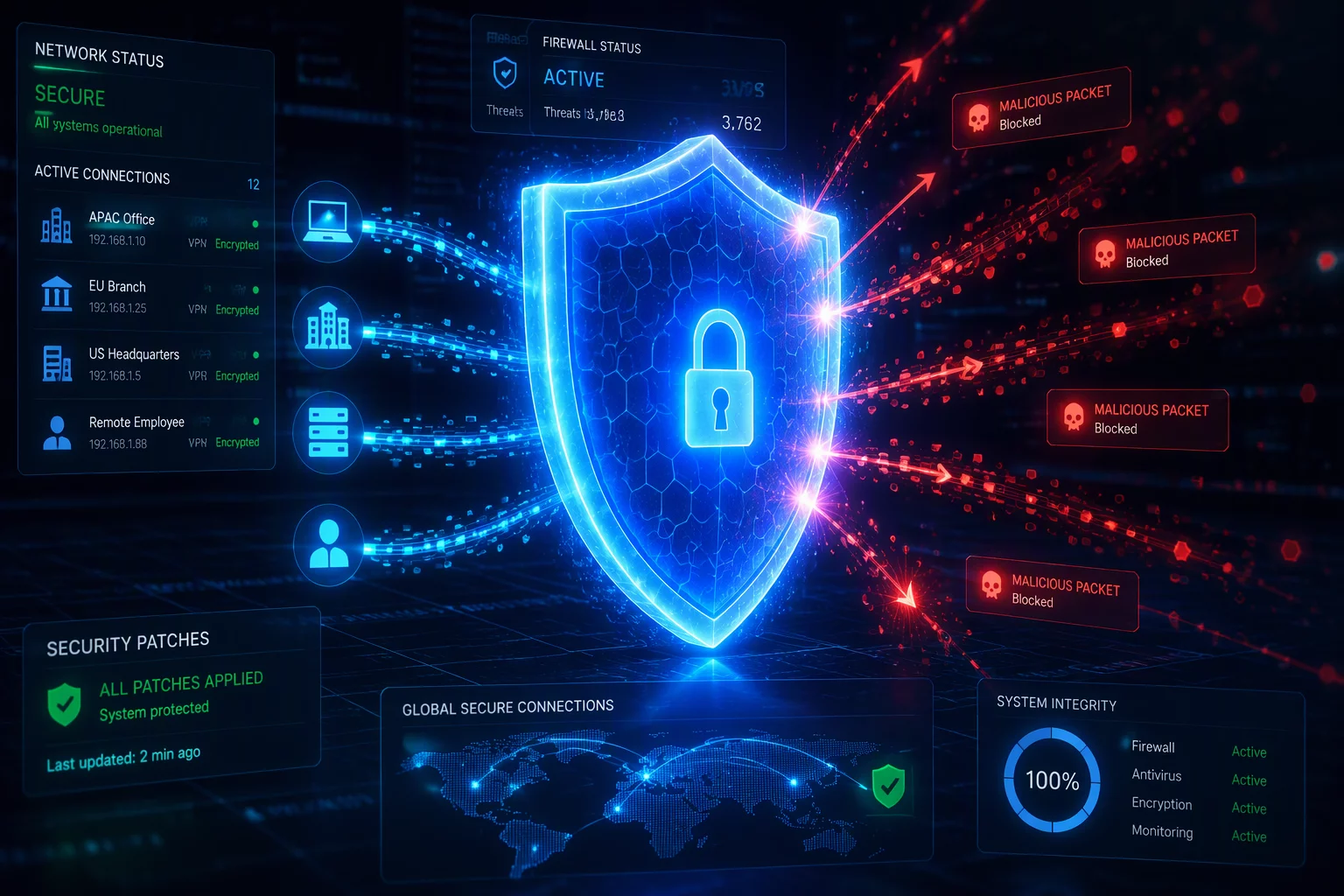
Essential Workflow Observations
- Cumulative security updates enforce stricter CredSSP validation, which can introduce handshake latency during high-frequency reconnection cycles.
- Hardened UDP transport parameters mitigate packet-level vulnerabilities while requiring manual tuning for smooth multi-monitor redraws.
- Virtual channel restrictions directly influence bidirectional clipboard fidelity and background peripheral passthrough stability.
Table of Contents
Primary Vector Modifications
CredSSP Handshake Integrity
Mandatory enforcement of updated encryption levels eliminates downgrade vulnerabilities while introducing distinct authentication validation overhead.
UDP Transport Throttling
Enhanced packet inspection routines stabilize packet delivery across unmanaged networks at the cost of slight baseline buffer latency.
Virtual Channel Isolation
Strict memory boundaries around clipboard and audio pipelines protect host memory space from malformed remote client payloads.
Session Persistence Guard
Reconnection timeouts now verify cryptographic token freshness, terminating stalled ghost sessions with strict determinism.
Balancing Robust Host Defense with Remote Workflow Efficiency
Deploying enterprise security baselines to Windows Remote Desktop Protocol hosts regularly alters the delicate balance between impenetrable boundary defense and seamless operational velocity. When engineering teams patch critical vulnerabilities within the remote rendering pipeline, the immediate outcome is stronger resistance against remote code execution and unauthorized channel injections. However, these architectural safeguards frequently modify how visual data frames and peripheral signals traverse the network boundary.
In distributed settings, operators interacting with high-resolution dual-monitor setups notice subtle changes in redraw responsiveness immediately following cumulative security updates. By prioritizing cryptographic verification across every packet, the host kernel consumes minor CPU cycles before dispatching drawing primitives to the remote client. Understanding these trade-offs allows teams to adjust graphics profile buffers and disable redundant local redirection features, recovering smooth pointer tracking and immediate keystroke acknowledgment.
Hardening remote protocols is never just a backend IT task; it directly shapes the tactile rhythm and responsiveness of an operator's daily session.
— James Smith, Infrastructure Architect
Long-term workflow continuity depends on isolating critical administrative sessions from general productivity pipelines. When configuring local endpoints to communicate with secured Windows hosts, adopting dedicated network profiles and verifying MTU alignment prevents unnecessary packet fragmentation. This holistic approach ensures that security compliance never degrades the essential fluidity required for demanding development and systems administration tasks.
Patch windows create a direct tension with session availability. Security updates that require session-host restarts force a choice between applying fixes promptly and preserving user context; environments that schedule patch application during documented maintenance windows — rather than opportunistically — eliminate the surprise disconnections that destroy unsaved remote work.
CredSSP and NLA changes are the most disruptive patch class for remote workflows. When a security update alters authentication negotiation, saved credentials and single sign-on chains can fail silently, leaving operators locked out of hosts they managed yesterday. Testing authentication paths immediately after patching — before users report failures — converts reactive incidents into planned verification.
Ringed deployment models apply cleanly to RDP hosts. A canary ring of session hosts receiving patches 48 hours before the general pool surfaces compatibility issues — smart-card redirection breakage, audio mapping regressions, printer driver conflicts — while the blast radius is still small enough to manage manually.
Rollback paths must be rehearsed, not assumed. A security patch that degrades remote session quality is itself an operational incident, and the teams that recover fastest are those with documented uninstall procedures, snapshot points, and a pre-approved exception process for hosts where the patch proves more harmful than the vulnerability it addresses.
Key Configuration & Impact Metrics
| Operational Parameter | Standard Context | Optimal Recommendation | Impact Factor |
|---|---|---|---|
| CredSSP Encryption Oracle Remediation | Vulnerable / Permissive | Force Mitigated / Strict | High Security / Moderate Latency |
| RDP UDP Transport Security | Default Dynamic Fallback | Enforced DTLS 1.3 Baseline | Zero Eavesdropping Risk |
| Clipboard Channel Virtual Isolation | Unrestricted Direct IPC | Memory-Buffered Tokenized Passthrough | Low Overhead / High Stability |
| Session Reconnect Token Lifetime | Indefinite Cached State | 30-Minute Cryptographic Refresh | Minimal Disruption |
Discussion & Insights
No comments yet. Be the first to leave a comment.
Leave a Methodological Observation