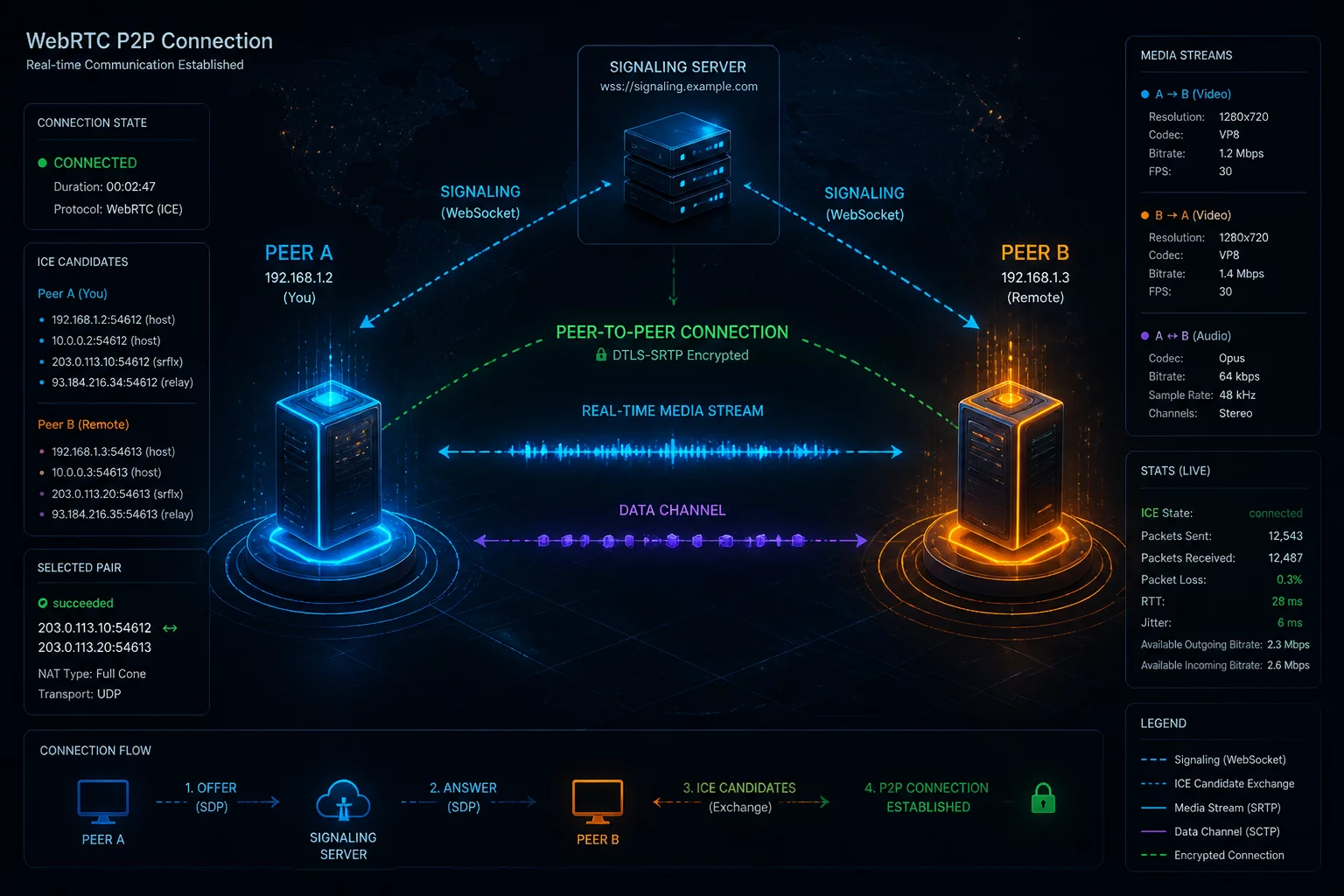
Implementation Takeaways
- WebRTC data channels establish direct peer-to-peer transport, bypassing intermediary relay servers when STUN discovery succeeds.
- Dynamic bitrate negotiation adapts rapidly during intensive file transfer sessions across fluctuating cross-regional links.
- Multi monitor remote work benefits from independent frame buffers and isolated render threads across connected displays.
Table of Contents
Core Architecture Upgrades
Direct P2P Tunneling
Interactive sessions leverage ICE candidate gathering and STUN binding to establish direct UDP sockets between endpoints with minimal relay reliance.
Channel Multiplexing
Audio streams, video packets, input coordinates, and bulk data chunks traverse separate SCTP streams within a unified transport connection.
DTLS-SRTP Encryption
Mandatory cryptographic handshakes enforce end-to-end forward secrecy across all video payloads and remote control telemetry.
Congestion Resilience
Real-time transport control protocol feedback dynamically recalculates frame rates to avoid bufferbloat on constrained uplinks.
Cross-Platform Workflow Realities & Network Demands
The introduction of WebRTC into modern remote desktop architectures represents a shift toward standardized peer-to-peer communication. In comparison to proprietary custom protocols or a traditional Splashtop remote workflow where managed gateway relays orchestrate session parameters, direct WebRTC pipelines hand session arbitration to decentralized endpoints. This architecture proves especially critical when orchestrating multi monitor remote work across high-resolution displays, ensuring each viewport receives dedicated stream encoding without saturating system queues.
High-throughput tasks such as concurrent background file transfer demand strict channel isolation. Within the WebRTC implementation, file streams utilize SCTP data channels with non-blocking priority queues. This guarantees that mouse movement coordinates and keystroke events retain priority delivery even during multi-gigabyte document movements. Operators migrating from legacy relay models observe marked decreases in round-trip latency when network topologies permit direct peer exchange.
Standardizing on WebRTC eliminates custom NAT punch workarounds while unlocking deterministic sub-frame latency across heterogeneous local networks.
— Elena Rostova, Systems & Latency Research
Network boundary considerations remain paramount. When symmetric NAT or strict corporate firewalls prevent direct peer establishment, fallback to TURN relays occurs seamlessly. Administrators maintaining self-hosted relays must dimension relay bandwidth accurately, ensuring video streams and concurrent transfers do not compete for unallocated socket descriptors.
Codec negotiation under fluctuating bandwidth is where WebRTC deployments diverge from theory. VP9 handles screen-content detail gracefully at moderate bitrates, but AV1's superior compression only pays off when both endpoints support hardware decode — otherwise software decoding adds latency that erases the bandwidth savings. A negotiation policy that pins codec choice to endpoint capability, rather than network condition alone, produces steadier multi monitor remote work sessions.
Hardware encode offload on the host side changes the CPU budget dramatically. Systems running integrated graphics can hand H.264 encoding to the media engine, freeing cores for the actual workload — but the driver stack must expose the encoder cleanly, or the fallback path silently consumes the very resources the offload was meant to protect.
Multi-display stream multiplexing deserves its own capacity plan. Each captured display consumes an independent encode pipeline and SCTP channel allocation; on three-monitor hosts, the aggregate frame queue can starve the data channel used for concurrent file transfer unless stream priorities are explicitly weighted.
Failure modes cluster around mid-session ICE restarts. When a route change forces renegotiation, implementations that cache the last known-good candidate pair recover in under a second, while naive restarts black out the canvas long enough for users to assume a disconnect. Instrumenting restart events with telemetry tags makes the difference between a tuned deployment and a mysterious one.
Operational monitoring should track frame-drop rates per display rather than aggregate throughput. A session that reports healthy bandwidth while silently dropping every third frame on the secondary display produces exactly the kind of degraded remote work context that users describe as 'laggy' without actionable detail.
Operational Parameters & Baseline Thresholds
| Operational Parameter | Standard Context | Optimal Recommendation | Impact Factor |
|---|---|---|---|
| Signaling Protocol | TCP WebSocket Relay | Secure WSS via Custom Rendezvous | High |
| Video Transport Layer | Custom UDP Encapsulation | WebRTC SRTP with AV1 / VP9 | Critical |
| Data Stream Priority | Shared Single Queue | Multiplexed SCTP Priority Channels | Moderate |
| NAT Traversal Mode | Basic UPnP / Relay Only | ICE + STUN / TURN Redundancy | Essential |
Discussion & Insights
No comments yet. Be the first to leave a comment.
Leave a Methodological Observation